

What is the difference between structured and unstructured data? Explanation including the characteristics of each
Last Updated: 2025 / 03 / 10
Published:

With the spread of IoT and machine learning, data has become more important than ever. In line with this trend, technical terms such as "structured data" and "unstructured data" have come to be used in the business world. However, many people may not be familiar with the meaning of "structured data" and "unstructured data" and the differences between them. In this issue, we will explain the difference between structured data and unstructured data, including the advantages and disadvantages of each.
- What is Structured Data?
- Benefits of Structured Data
- Disadvantages of structured data
- What is unstructured data?
- Benefits of Unstructured Data
- Disadvantages of Unstructured Data
- Difference between structured and unstructured data
- What is semi-structured data?
- Understanding the difference between structured and unstructured data for effective data utilization
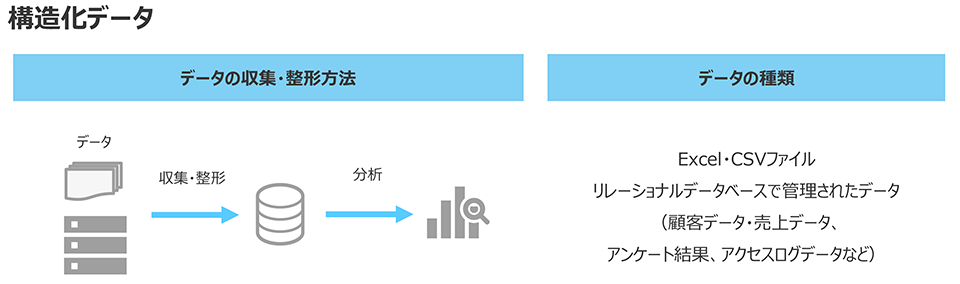
Structured data is data that has rows and columns and is formatted into a predefined structure, such as Excel. It is also called schema-on-write.
Data managed in a tabular format, such as a relational database, is the main example of structured data, which can include corporate customer data, access log data, and many other types of data. Because structured data is well-formatted, it can be easily retrieved and updated using the database language SQL.
Let's then look at the benefits of structured data.
Easy to use in machine learning
Clearly defined and organized fields make it easy to manipulate data by creating and executing queries.
User-friendly
Since the data is pre-formatted, anyone with knowledge of the data being handled can use the data. It is not necessary to understand the content or relationships of the data.
A wide variety of tools available
A number of tools have been released by various companies that have been tried and tested in the use and analysis of structured data. Data managers can choose the tool that best suits their situation.
Structured data has not only advantages, but also disadvantages. Let us look at the disadvantages here.
Difficult to use for other purposes
The reality is that data with a predefined structure is difficult to use for anything other than its set purpose. Flexibility and use of data analysis will be limited.
Significant costs associated with changing requirements
Changes in data requirements will almost always require updating all structured data. This cost can be significant, and depending on the nature of the requirements, storage may need to be expanded. Using cloud-based storage can compress costs because it can be scaled to any size at a later time and there are no maintenance costs for the equipment.
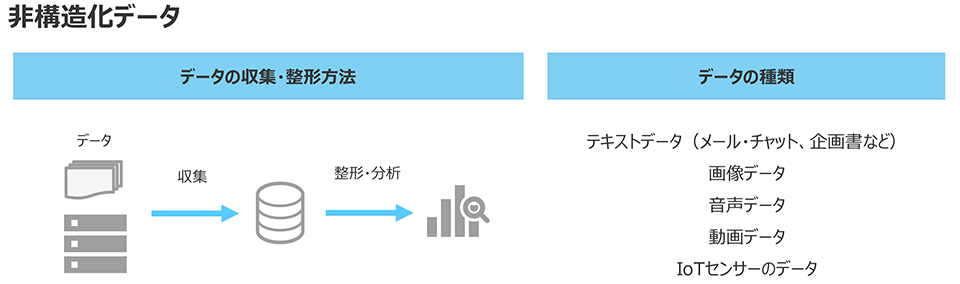
Unstructured data refers to data that is not pre-formatted, stored in its original format, and not processed until time of use. It is also called schema-on-read.
Text data from emails and chats, data from IoT sensors, images, and voice data are the main types of unstructured data.
Let's also look at the benefits of unstructured data.
Available in any format
Data is stored in the state in which it was generated, allowing for flexible use of data according to the application.
Quickly gather data.
It takes a certain amount of time and effort to process data in a well-formed format. Unstructured data is characterized by the fact that it does not need to be formatted when data is collected, making it easy to collect large amounts of data efficiently.
There are also multiple disadvantages of unstructured data. Let's look at them one by one.
Time-consuming to use the data
Since there is no fixed format, the data cannot be used as is. It is necessary to become familiar with the contents of the data and related issues.
Fewer tools available
Most data analysis tools available in the world are for structured data, and the choice of tools is limited.
The difference between structured and unstructured data is as follows
| structured data | unstructured data | |
|---|---|---|
| Ease of data use | easy to use | difficult to use |
| Ease of data collection | hard to collect | Easy to collect |
| Flexibility of data use | not(verb-negating suffix; may indicate question or invitation with rising intonation) | be (usu. of inanimate objects) |
| Abundance of analytical tools | wealth | few |
We need to understand these differences before we can make use of the data.
Data that is included in unstructured data but has a certain degree of structure is called semi-structured data. Specifically, it mainly refers to XML and JSON data.
Since the structure is determined to some extent, some of them can be converted to structured data if they are organized. Also, data retrieval and analysis can be performed more efficiently than with unstructured data.
Structured data is data that is defined according to a predefined purpose. In contrast, unstructured data is data that is undefined and highly flexible. Both types of data have their advantages and disadvantages, so it is important to understand their characteristics to make efficient use of data.
Cross Marketing provides consultation on data utilization and data conversion for both structured and unstructured data. Please feel free to contact us if you are interested in making effective use of data assets lying dormant in your company.
■Reference site:
https://www.talend.com/jp/resources/structured-vs-unstructured-data/
https://solution.toppan.co.jp/digital/contents/cdp_contents07_0831.html
https://www.purestorage.com/jp/knowledge/big-data/structured-vs-unstructured-data.html
https://infogov-labo.jp/articles/what-is-structured-data-and-unstructured-data/
https://www.seagate.com/jp/ja/solutions/data/big-data/structured-vs-unstructured-data/
https://www.boxsquare.jp/blog/what-is-unstructured-data
https://www.netapp.com/ja/data-storage/unstructured-data/what-is-unstructured-data/
https://www.integrate.io/jp/blog/structured-vs-unstructured-data-key-differences-ja/
https://www.soumu.go.jp/ict_skill/pdf/ict_ev_el_3_1.pdf
https://thinkit.co.jp/article/18514