


The respective ratios of owner-occupied versus rental housing can be found in the Ministry of Internal Affairs and Communications' Housing and Land Statistics Survey. Let's explore how the ratio of owner-occupied to rented housing has changed over the 40 years from 1978 to 2018.
Reference:http://www.stat.go.jp/data/jyutaku/index.html
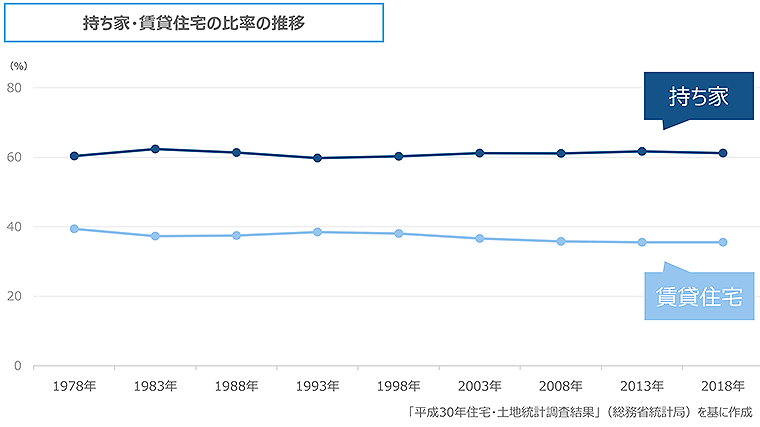
The percentage of owner-occupied homes is around 60% and has not changed significantly
In 1978, 60.4% were owner-occupied and 39.4% were renters. Forty years later, in 2018, the owner-occupied rate was 61.2%. Along the way, the owner-occupied home rate declined from 1988 to 1993 to 59.8%, but overall the rate has not changed significantly.
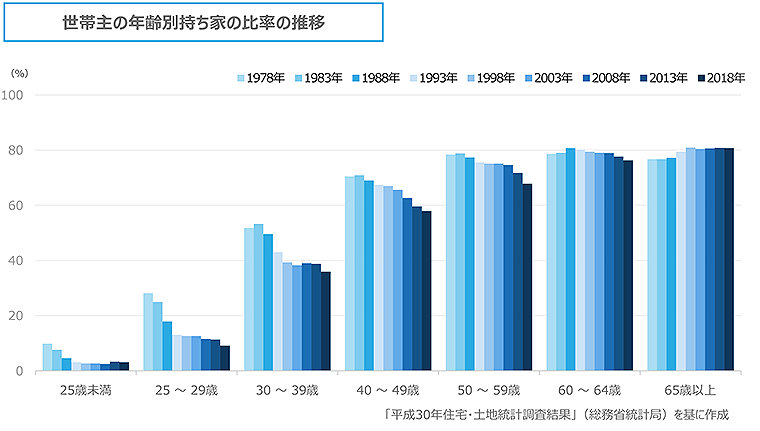
Owner-occupied homeownership rates from late 20s to under 40s are declining.
A look at homeownership rates by age shows a particularly large decline in the homeownership rate among young people: in 1978, the homeownership rate among 25- to 29-year-olds was 28.1%; by 2018, it had dropped 19 percentage points to 9.1%. 30-somethings also saw a decline, falling 15.9 percentage points since 1978 to 35.9%. Only the 65+ age group (4.1 percentage points) has seen an increase in the homeownership rate over the past 40 years, while all other generations have seen a decline across the board.
Timing of home purchase moves from 30s to 40s
In 1978, the homeownership rate among those in their late 20s was 28.1%, while among those in their 30s, the rate rose significantly to 51.8%, indicating that the majority of people in their 30s purchased homes between 1978 and 1983. However, over time, the homeownership rate among 30-somethings has begun to decline, and people's lives are changing dramatically.
In 2018, the homeownership rate among 25-29 year olds dropped to 9.1% and the homeownership rate among 30-somethings dropped to 35.9%. About 40 years ago, more than half of people in their 30s owned a home, whereas today only about 30% of people own a home, and the homeownership rate only reaches a majority when people are in their 40s (57.9%). 40 years ago, the majority of people bought a home in their 30s, but today, more people in their 40s own homes. In contrast to 40 years ago, the majority of homeowners were in their 30s when they purchased their homes.
In general, people tend to think that as land and building prices fall, the hurdle to purchase housing decreases and the owner-occupied house rate rises. However, even after the Lehman Shock, when housing prices fell sharply over the past 40 years, the owner-occupied house rate has hardly changed at all.
Then, what factors cause the ratio of owner-occupied and rental housing to change?
Lifestyle Changes
The first possible factor is a change in lifestyle.
For example, with the recent mass media coverage of the 20 million yen retirement age problem, it is not surprising that more and more people are choosing to rent rather than take out expensive mortgages if they do not want to take on large debts for the future.
Late marriages and late childbearing may also have no small effect on the change in the ratio of owner-occupied houses.
According to the Cabinet Office's "White Paper on Measures for Society with Declining Birthrate," the average age of first marriage in 2017 compared to 1985 increased by 2.9 years for men and 3.9 years for women, and the age at which the first child is born also increased by 4.0 years.
Reference:https://www8.cao.go.jp/shoushi/shoushika/whitepaper/measures/w-2019/r01webhonpen/html/b1_s1-1-3.html
Many families purchase owner-occupied homes with more space as their families grow, but while the rate of homeownership in the 20s and early 30s may decrease as people marry later in life and have children later in life, the rate of homeownership may increase in the late 30s and 40s.
Changes in the way we work
According to data from the Ministry of Internal Affairs and Communications, from 1978 to 1983, the majority of home purchases were made in the 30s. Since owning a home requires a large amount of capital, many people are likely to purchase a home when they are still in their prime working years.
In the past, people retired at the age of 55 or 60, but nowadays, more and more people continue to work until they are nearly 70 because they can sign a contract to be reemployed. As a result, the age of those in their prime working years is increasing from their 30s to their 40s and 50s, and as a result, the homeownership rate among those in their 30s may be on a downward trend.
Changes in rental services
As times change and rental services become more convenient, it is possible that more people will choose rental housing over home ownership.
For example, recently there has been an increase in the number of rental houses that support customization and DIY. Since condominiums and apartments can be rearranged to suit one's personal preferences, the need to purchase an owner-occupied house has become less of a necessity.
In addition, the superiority of rental housing is also increasing, as it is now possible to sign a rental contract even for condominiums and single-family homes for sale. This improvement in the quality of rental services may lead to a decline in the owner-occupied home ratio, which has remained virtually unchanged for 40 years.
Knowing the advantages and disadvantages of homeownership will help you know who is suited for homeownership. Advantages and disadvantages include the following
【Advantages of owning a home】
・Can be booked as an asset and may be redeemed in the future
・Paying off the mortgage will reduce expenses and make it easier to afford living expenses
・Remodeling and rebuilding without having to ask permission from the owner
・Security with group credit life insurance in case something happens to the loan holder
【Disadvantages of owner-occupied houses】
・Heavy financial burden of mortgage repayment
・If maintenance is required, you have to arrange it all by yourself
・Not easy to change residence
・May cause trouble among family members when inherited
Based on the above advantages and disadvantages, the following people are suited for owner-occupied housing
Have a stable income and be able to pay off the mortgage before retirement
Mortgages can act as both an advantage and a disadvantage. If you are able to pay off your mortgage, you will be relieved of the heavy burden of repayment, and it will be easier to lead a comfortable life thereafter. However, mortgages must be paid for up to 35 years, and until they are paid off, the burden of repayment is heavy.
Therefore, when purchasing a home, the first requirement is to have a stable income. Even if you receive a stable salary when you first take out the loan, a downturn in the economy or the recent coronavirus may cause your income to suddenly cease. When taking out a loan, it is necessary to think carefully about the future and be prepared to repay the loan without fail.
People who want to leave their family a home they own as an inheritance.
The appeal of owner-occupied homes is that they can be used as assets for a wide range of purposes. Selling an owner-occupied home can provide a large sum of money as well as social credit. Therefore, for those who want to leave assets to their spouses, children, grandchildren, etc., owner-occupied houses are more suitable than rental houses.
However, it is important to note that when there are multiple heirs, trouble is likely to arise over inheritance.