


PPM analysis is an analytical method to classify business activities and the company's products into four positions based on market growth rate and market share, and to allocate management resources appropriately for investment.
This method was proposed by the Boston Consulting Group in the 1970s in the U.S. PPM is an acronym for "Product Portfolio Management.

By using PPM analysis, the standing of a business or product can be grasped objectively, and decisions on active investment or withdrawal and investment allocation can be examined effectively. It is a method suitable for utilizing corporate resources without waste.
Here, we introduce the four positions that are important in PPM analysis: Star, Cash Cow, Problem Child, and Dog.
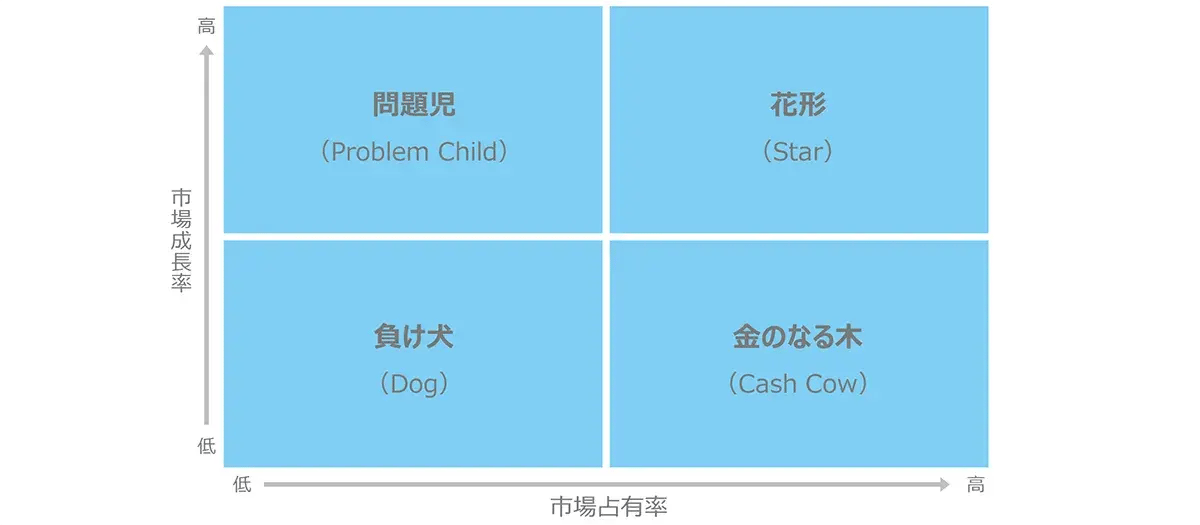
Flower Shape (Star)
Flowering represents a position that has a high market growth rate and market share, both of which are high among the four positions.
Although the growth rate is high and future potential is promising, there are many rivals in this position, and market competition is expected to intensify.
In order to maintain a high market share and take full advantage of the market's growth rate, aggressive investment is desirable. We would like to focus on capital investment and sales promotion activities.
Cash Cow
The money tree is a position with a high market share but low market growth.
It is a business or product with few new entrants due to the slow growth of the market. Although the high market share provides stable profits, the future potential is not very promising.
In this phase, the company should refrain from aggressive investment and consider future trends with a view to withdrawing from the market.
Problem Child
A problem child represents a position with a low market share, although it has a high market growth rate and promising future prospects.
The position is difficult to generate profit from the business activity or the product itself due to the low market share, and there is a high risk of loss due to intense market competition.
However, since this is a position with growth potential, if the market share can be increased, the company may be able to transition into a flower or a money-making tree in the future. Aggressive investment based on the situation is important for this position.
Loser (Dog)
A loser is a position with low market growth and market share.
Not only do they have a low market share and are not profitable, but they also have no future potential, and if left unchecked, risk losses. In some cases, this can be a cause of serious risk in management.
For businesses or products classified as losers, early decisions must be made to withdraw or sell the business.
What are the benefits of using PPM analysis in business strategy?Here are two benefits of PPM analysis.

1. To be able to look at their business and services objectively
It is not easy to objectively view one's own services, but PPM analysis allows one to visualize the market growth rate and market share, and thus objectively view the position of one's own services.
Especially for newly launched businesses, it is difficult to determine whether or not to continue investing in the business.
PPM analysis makes it easier to determine from a rational perspective whether there is room for growth and whether the service is worth continuing to invest in.
2. Able to make business decisions that are not limited by the numbers in front of them
If we get too caught up in figures such as losses and surpluses, we may end up making the wrong business decisions.
For example, even if a company is in the red, if there is room for growth and market share expansion is expected, there is a possibility of large profits in the future by aggressive investment. If we withdraw from a business just because it is in the red, we may destroy its future potential.
Conversely, there may be areas that appear to be doing well in the black, but will shrink in size in the future.
If you focus only on deficits or surpluses, you will not be able to make the right business decisions at the right time. PPM analysis is also a beneficial analysis method in that it can be used for decision-making based on growth potential and the company's position in the market.
While we have discussed some of the advantages of PPM analysis, PPM analysis also has disadvantages, and when using PPM analysis, keep the following two disadvantages in mind.

1. Inability to analyze from multiple perspectives
The market growth rate and market share used in PPM analysis are not fixed absolute values. Moreover, since PPM analysis looks at market growth rate and market share from two angles, it has the disadvantage of not being able to reflect all elements of a business.
PPM analysis tends to ignore relationships among businesses and products because it does not take a multidimensional view of a business or product as a stand-alone indicator.
For example, if a company has multiple businesses, making management decisions based on only four positions may lead to erroneous business decisions, such as not taking into account productivity gains or synergies among businesses, which may result in the decline of a steady business.
2. Overlooking disruptive innovation
PPM analysis is an analytical method that assumes the existence of experience effects (that an increase in cumulative production lowers costs by a certain percentage), economies of scale (that an increase in production by a certain facility lowers costs), and product life cycles.
In other words, PPM analysis can only analyze existing businesses and products, and is not suitable for developing future business and product strategies.
By relying too much on PPM analysis, you may miss such opportunities.