


This section explains the meaning and characteristics of each generation.The age is based on the assumption that the birthday is in the year 2023.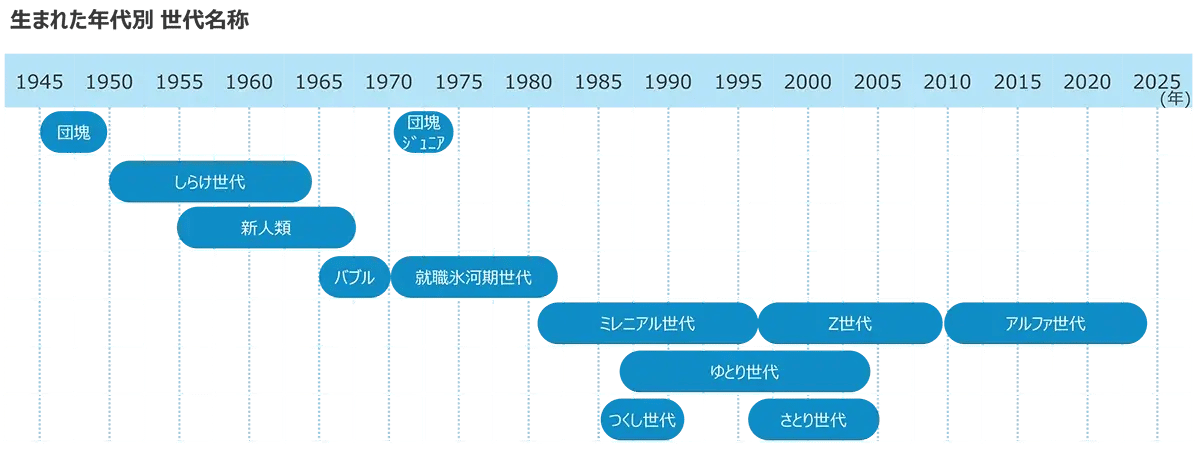
Baby boomers (those around 74 to 76 years old)
The name "baby-boom generation" comes from the novel "The Baby-Boomer Generation" by Taichi Sakaiya. It refers to people born during the first baby boom, a generation with a very large population.
Baby boomers tend to have a strong sense of competition and camaraderie, and a strong belief that hard work pays off. At the same time, they are also characterized by their sensitivity to trends.
Shirake Generation (people around 59-72 years old)

Shirake generation comes from the verb "to be sober.The term "Shirake" comes from the fact that the baby boomers were involved in the student movement, while the slightly younger generation is apathetic and indifferent to politics and the economy.In addition to being apathetic and indifferent, people of the Shirake generation also tend to be irresponsible.They are highly individualistic and value their private lives.They also tend to be nerdy, having grown up at a time when television and anime were becoming popular.
New generation (those around 59-68 years old)
The term "neonates" was coined by Japanese economist Shinichiro Kurimoto. The term "neophyte" was coined by Japanese economist Shinichiro Kurimoto because of their different sensibilities and values from those of the past.
One of the main characteristics is that they tend to be friends with their own children. As a generation that grew up during the period of rapid economic growth, they are characterized by a high level of consumerism. They also tend to respect the individual because of the overlap with the "Shirake" generation.
Bubble generation (those around 53-58 years old)
The "bubble generation" originated from the bubble economy that began with the Plaza Accord in 1985.Since this generation entered the workforce during the boom years, they are active consumers.They tend to prefer brand-name products.In addition, they are characterized by good communication skills and a strong sense of loyalty to the company.
The generation in the "ice age" of employment (those around 39-53 years old)
After 1991, when the bubble economy began to burst, the number of jobs hired by companies declined due to the economic downturn, and the employment rate dropped significantly. The term "job-hunting ice age" was coined to compare the situation to the ice age.
Since they entered the workforce during the recession, they tended to focus on saving money. Many people are stoic about their work and have acquired qualifications. They are cautious and objective in their approach to things.
As a generation raised in the early days of the Internet, they are flexible to changes in the environment.
Baby boomers (those around 49-52 years old)
The junior baby boomers are the generation born during the second baby boom.They are covered by the "ice age" generation in terms of employment.Since their parents were baby boomers, they were called the baby-boom junior generation, with "junior" added.They experienced the "ice age" of employment and have a strong conservative mindset.They are mentally stronger than other generations, but many are characterized by a lack of self-confidence.They tend to be serious and focus on self-development.
Millennials (those around 26-42 years old)
Millennial means "of the millennium. Millennials are sometimes referred to as Generation M or Generation Y.
Millennials have a strong focus on cost-consciousness. They tend to value their private time and space. They are also characterized by a high level of health consciousness and a strong desire to take care of their bodies and mental health and keep them healthy.
Yutori Generation (those around 19-36 years old)
The "Yutori-generation" was named after the generation when compulsory education switched from the traditional cramming style to a more liberal education.Due to the influence of "Yutori" education, they are characterized by a low susceptibility to stress, a low sense of competition, and a low desire to move upward.On the other hand, many of them have a rational way of thinking.Compared to other generations, they tend to accept what they are told by those around them.
Satori generation (those around 18 to 27 years old)
This generation grew up in the recession following the bursting of the bubble economy and experienced major disasters such as the Great Hanshin-Awaji Earthquake and the Great East Japan Earthquake.Because they have experienced various events, many of them think like enlightened people and are called the "Satoru" generation.Since they have only experienced times of poor economic conditions, they show little interest in brands and prestige.They are more realistic than idealistic and prefer pragmatism.They are more solid and stability-oriented.In addition, they are digital natives, meaning that the Internet and IT devices were already prevalent when they were born.Therefore, the majority of the Satori generation is accustomed to dealing with digital tools and the Internet.
Generation Z (12 to around 28 years old)
In the U.S., those born between 1960 and 1974 are known as Generation X, and those born between 1975 and 1996 as Generation Y. Generation Z is said to have been named after Generation Y.Due to the influence of the "Yutori" education system, they are susceptible to stress and have a low sense of competitiveness and upward mobility.On the other hand, people of Generation Z, with their rational way of thinking, are keenly aware that values differ from person to person, and are characterized by valuing their own values.On the other hand, they also tend to seek connection with others and have a strong desire for approval.There is also a preference for intuitive rather than logical thinking.
Alpha Generation (13 years old and younger)

Alpha Generation means further after Generation Z.They have grown up amidst the proliferation of SNS and web services since childhood.As a result, they have a high affinity for social networking and virtual spaces.The parents of the Alpha generation are mainly millennials.Some are given smartphones and other digital tools by their parents at an early age and use them.