


According to the 2020 census conducted by the Statistics Bureau of the Ministry of Internal Affairs and Communications, the percentage of married men and women increases in their early 30s and late 20s, respectively, and the percentage of singles in the same age group tends to decrease.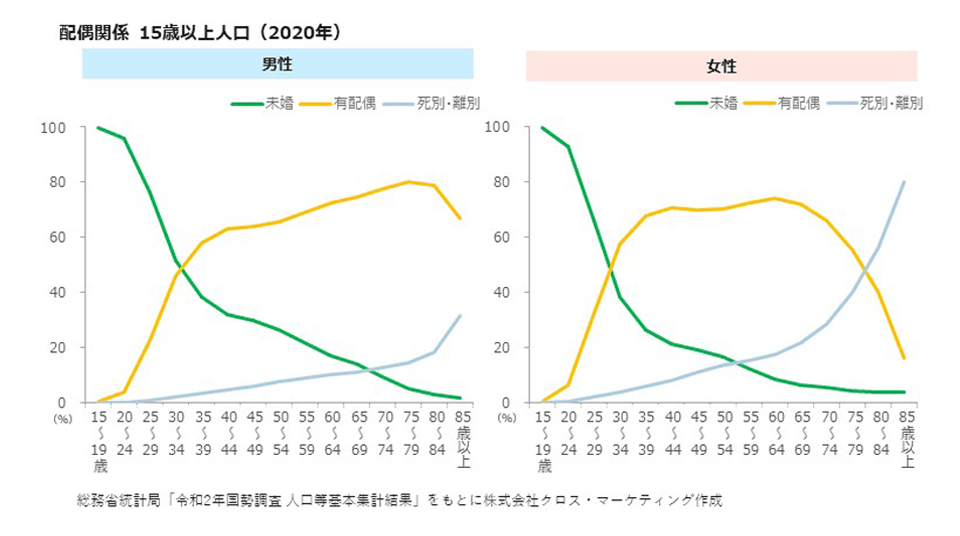
Source: "2020 Population Census, Basic Tabulation Results," Statistics Bureau, Ministry of Internal Affairs and Communications
https://www.stat.go.jp/data/kokusei/2020/kekka/pdf/outline_01.pdf
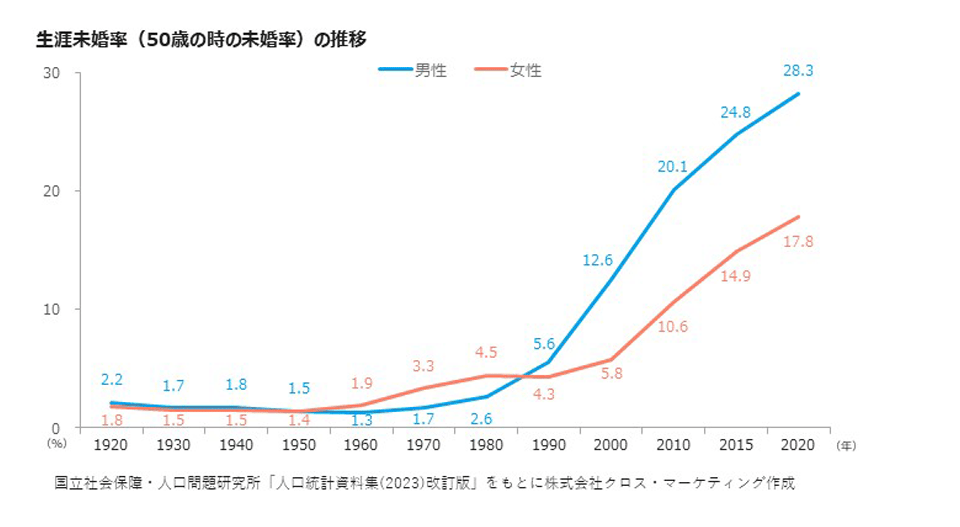
In addition, the unmarriage rate is generally higher for men than for women.According to the National Institute of Population and Social Security Research's "Population Statistics Data Book (2023) Revision," the lifetime unmarried rate is rising, reaching a record high of about 28% for men and 18% for women in 2020.
Source: National Institute of Social Security and Population Studies, "Demographic Data Collection (2023) Revision".
https://www.ipss.go.jp/syoushika/tohkei/Popular/P_Detail2023.asp?fname=T06-23.htm
The lifetime unmarried rate is calculated by averaging the unmarried rate of people between the ages of 45 and 54 at age 50; it is estimated that those who are unmarried at age 50 will remain unmarried in the future and is used as a figure for the lifetime unmarried rate.
The company's researchers predict that if the unmarriage rate continues at the current rate, one in three men and one in four women will be unmarried in their lifetime by 2030.
Furthermore, it is also said that the percentage of unmarried persons aged 15 and older will increase to 36.5% for men and 27.1% for women by 2050.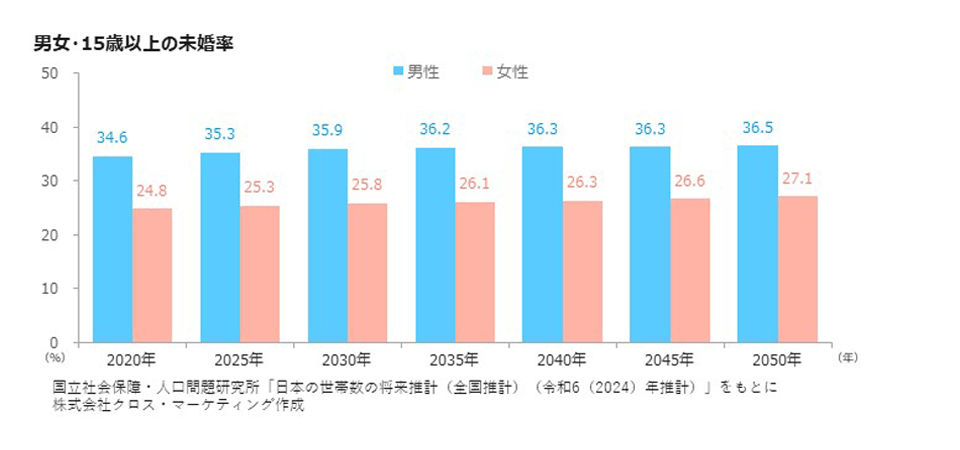
Source: National Institute of Population and Social Security Research, "Projections of the Number of Households in Japan (National Projection) (2024 Projection),"
https://www.ipss.go.jp/pp-ajsetai/j/HPRJ2024/hprj2024_gaiyo_20240412.pdf
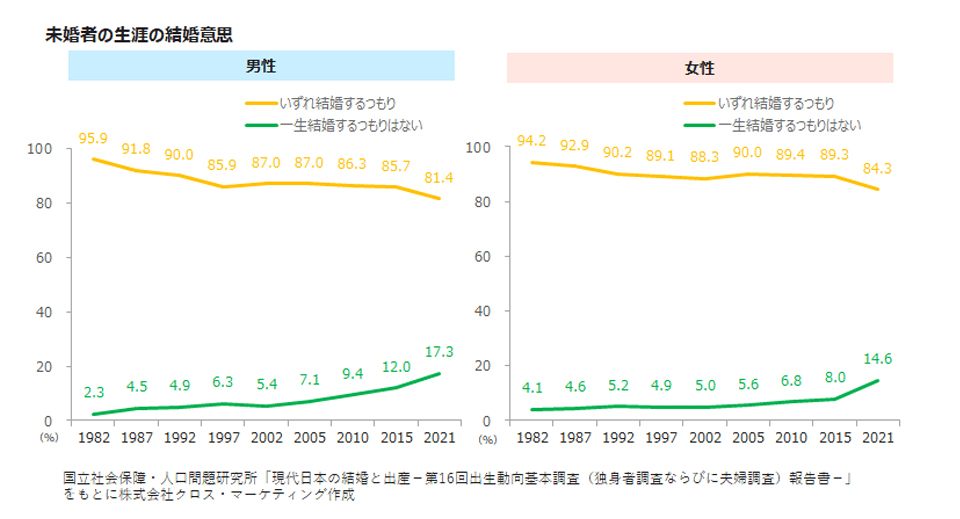
Besides, in the survey on marriage and childbearing, the percentage of people who are willing to get married who think they intend to get married eventually has dropped, regardless of gender, age, or lifestyle.
In the previous (2015) survey, 85.7% of men and 89.3% of women did so, compared to 81.4% of men and 84.3% of women in the current survey. Additionally, those who believe that they "do not intend to marry for the rest of their lives" have been on the rise since the beginning of 2000, with 17.3% of men and 14.6% of women in the current survey.
Source: National Institute of Population and Social Security Research, "Marriage and Childbearing in Contemporary Japan: Report of the 16th Basic Survey on Fertility Trends (Survey of Singles and Couples),"
https://www.ipss.go.jp/ps-doukou/j/doukou16/ JNFS16_reportALL.pdf
As of 2020, the percentage of single people is about 35% for men and 25% for women, and the percentage of unmarried people is expected to continue to rise.
So why are the number of single people increasing? Here are three possible factors.
Values and lifestyles are changing.
Marriage used to be considered a natural happiness, but nowadays this value has been transformed and an increasing number of people believe that it is not always necessary to be married. More and more people support the idea that personal life and values are more important than married life.
In the past, women often married and went into the home to be supported by their husbands, but as women entered the workforce, the economic gap between men and women has narrowed.
The enactment of the Equal Employment Opportunity Law has changed the way women work, and an increasing number of women are working as hard as men to earn a living. As a result, women's values have shifted to place more importance on work than on family, and it is thought that an increasing number of women prefer to spend their time working rather than getting married.

Not meeting the opposite sex for the future.
In the aforementioned "16th Basic Survey on Birth Trends," the most common reason given by those aged 25 and older for remaining single is "no suitable partner.
43.3% of men and 48.1% of women aged 25-34 gave the above as their reason. On the flip side, more than half of the respondents believe that they would be willing to get married [within a year] if they find an ideal partner.
Source: National Institute of Population and Social Security Research, "Marriage and Childbearing in Contemporary Japan: Report of the 16th Basic Survey on Fertility Trends (Survey of Singles and Couples),"
https://www.ipss.go.jp/ps-doukou/j/doukou16/ JNFS16_reportALL.pdf
In the days when marriage was the norm, it was commonplace for parents and relatives to propose arranged marriages, and for superiors at work to make marriage proposals to their subordinates. However, as the values of marriage have changed over time, arranged marriages have decreased, and the tendency for people around people to strongly encourage marriage has disappeared.
Lack of financial wherewithal
Many people cite lack of financial freedom as a reason. While living on one's own is all one can do, getting married adds a variety of expenses such as a new house, wedding, and childcare for children.
According to the 16th Basic Survey on Birth Trends, 60-70% of singles who want to get married feel that marriage is a hurdle, with many of them saying that "marriage funds are a hurdle. 47.5% of men and 43.0% of women feel that lack of financial resources prevents them from getting married.
Source: National Institute of Population and Social Security Research, "Marriage and Childbearing in Contemporary Japan: Report of the 16th Basic Survey on Fertility Trends (Survey of Singles and Couples),"
https://www.ipss.go.jp/ps-doukou/j/doukou16/ JNFS16_reportALL.pdf
What are the benefits of being single? Here are three advantages of being single.
Free up money and time for yourself
One of the advantages of being single is the freedom to spend money and time freely.
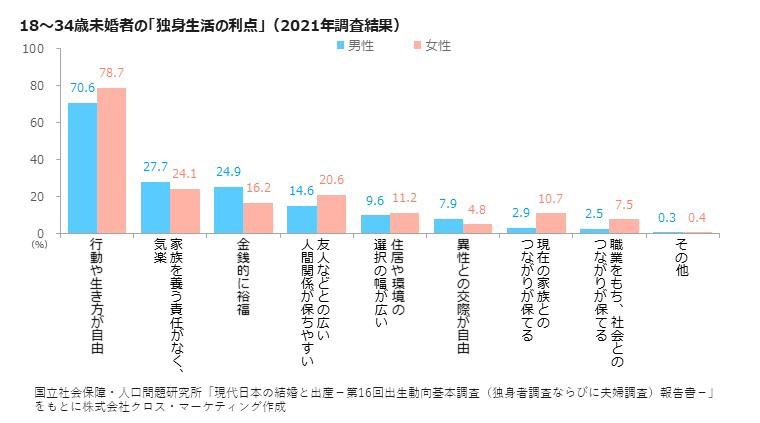
In the 1987 survey ("Marriage and Childbirth in Contemporary Japan: Report on the 9th Basic Survey on Birth Trends (Survey of Singles and Married Couples)"), the most popular answer was "freedom of action and lifestyle," which was still the top answer at 70.6% for men and 78.7% for women in the current survey. In this survey as well, "freedom of movement and lifestyle" remains at the top, at 70.6% for men and 78.7% for women.
Incidentally, "financially well-off" was selected by 24.9% of men and 16.2% of women. Since time and money are all theirs while single, many feel it is an advantage to be able to devote themselves to hobbies, work, and other things they like to do.
No responsibility to provide for the family is incurred.
Not having the pressure and responsibility of having to provide for a family is also an advantage.
According to the 16th Basic Survey on Birth Trends, 27.7% of men and 24.1% of women say this is an advantage, an increase from the previous survey (2015) for both men and women. Single people are considered to be more comfortable because they only have to be responsible for their own lives and do not have to take on other major responsibilities.
We can keep the relationships we've had.
If you get married, it may be harder to continue your existing friendships, and you cannot ignore your relationship with the other person's family. If they remain single, they can maintain their existing relationships, which is seen as an advantage.
In the "16th Basic Survey on Birth Trends," 14.6% of men and 20.6% of women ranked marriage as the fourth most beneficial for men and the third most beneficial for women, although the percentage has been decreasing over the years.
Source: National Institute of Population and Social Security Research, "Marriage and Childbearing in Contemporary Japan: Report of the 16th Basic Survey on Fertility Trends (Survey of Singles and Couples),"
https://www.ipss.go.jp/ps-doukou/j/doukou16/ JNFS16_reportALL.pdf
While there are many advantages to being single, there are also potential disadvantages. Here are three disadvantages that may arise from being single.
Feeling lonely or anxious
It is fine when you are healthy and free to devote yourself to your hobbies and work, but when you live alone and become ill or injured, you feel anxious about having to deal with everything alone. Since people can become feeble when they are ill, feeling lonely is a disadvantage of being single.
With the rate of elderly people living alone increasing and lonely deaths becoming a hot topic in the media, some people may feel anxious about being single when they think about their old age.
I have family members who are concerned about me.
If you remain unmarried, your relatives and family may ask, "Are you married yet?" If you remain unmarried, your relatives and family may ask you, "Are you married yet? Many parents have lived in a society where marriage is the norm, and they worry about their children who do not show any signs of getting married.
It is a disadvantage to have relatives and family members worry about you and rush you into marriage. Many people may be fed up with the idea of marriage being brought up every time they return home. Some may be told by the older generation that they cannot become a full-fledged member of society unless they get married, and some may feel guilty compared to their married friends and peers of the same generation.
With the increase in the number of single people, the consumer market is also changing. While in the past, going out for outings or leisure activities was strongly perceived as something to do with family or friends, recently the number of people going out alone has been increasing, giving rise to the term "solo activities.
According to the "Solo Consumption Survey (2022) Outings and Leisure," 42% of respondents have gone on an outing or visited a leisure destination alone in the past year.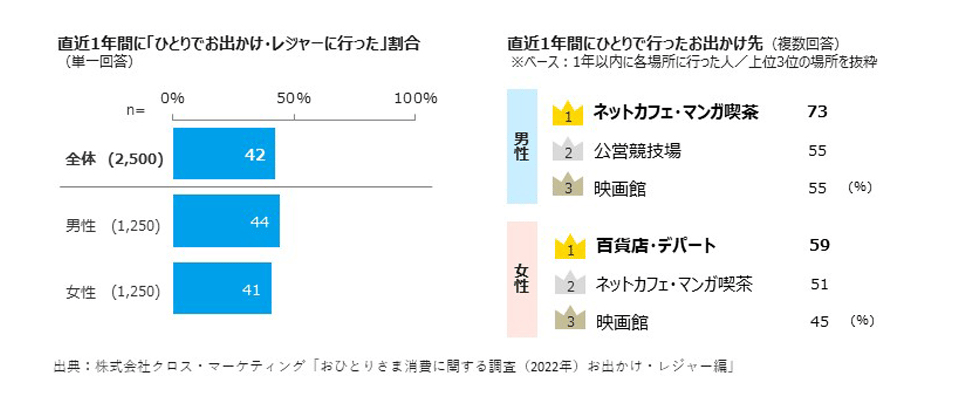
Source: Cross Marketing Inc.
※Switch to Japanese
「Survey on One-Person Consumption (2022) Outings and Leisure」
Internet cafes and stadiums were popular solo activity destinations for men, while department stores and Internet cafes were popular for women. The advantages of going out alone were cited as reasons for being able to look around freely and to spend time at one's own pace.
The number of people eating out alone is also increasing. According to the "Solo Consumption Survey (2022) Eating Out", 58% of men and 40% of women have dined out alone in the past year.
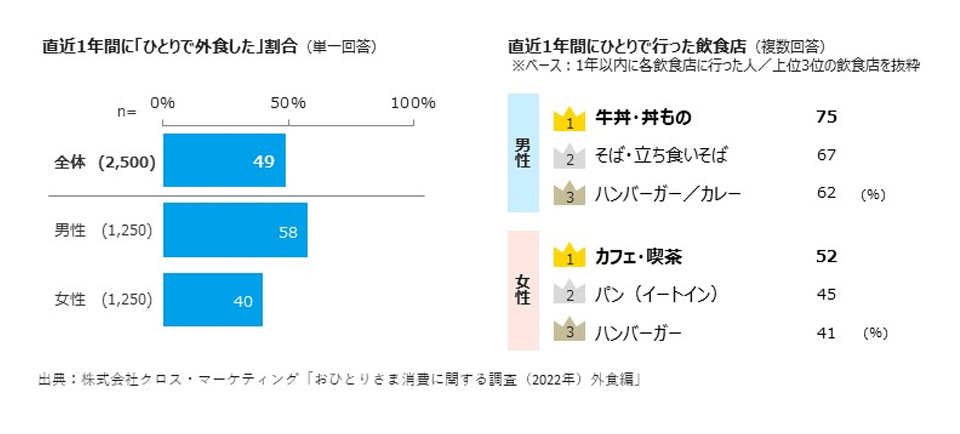
Source: Cross Marketing Inc.
※Switch to Japanese
「Survey on One-person Consumption (2022) Eating out」
Beef bowls and soba noodles are popular among men, while cafes and eat-in baked goods are popular among women. The advantages of eating out alone include freedom and the ability to savor the food at a leisurely pace.